
Even if you have thousands of backlinks, sometimes a new site with fewer links can overtake you. Most SEOs find this hard to believe, but it happens frequently. Why does this happen? Maybe that new site has something that you don't. Topical authority.Google has gradually changed the way it ranks websites. The number of raw links is no longer as significant as it once was. Now, Google is placing greater importance on depth.
Sites that cover a topic so well that they become the main reference for people. Simply put, this is topical authority. And building it is one of the best-performing SEO strategies today.This guide explains what topical authority is, why it's so important, and, most importantly, shows you how to systematically build it clearly. Whether you're starting from scratch or looking to strengthen your existing site, it's useful for both situations.
Table of Contents
ToggleWhat Is Topical Authority in SEO?
Topical authority in SEO is the level of expertise and trust that a website has built around a certain topic. Search engines view this based on how deeply and completely a site covers that topic. Sites that can answer almost all important questions related to a single topic are rewarded by Google with better rankings and greater visibility.
How Google recognises topical authority:
- The site covers the topic from many angles, subtopics, and search intent points.
- The content is logically connected to each other, so that Google can clearly understand the structure of the topic.
- The individual pages also reinforce each other thematically.
- And over time, the site continues to publish relevant and accurate content.
You can think of it like academic credibility. A professor who has written 20 papers on machine learning is considered more credible in that field than someone who has written just one good paper and three unrelated papers. Google uses a similar logic when ranking websites.
Topical Authority vs. Domain Authority
Domain Authority (a third-party metric from Moz) measures the strength of a link. Topical Authority, on the other hand, is about the depth of the subject matter. They are two different things, and confusing them with each other can be a misleading strategy. For example, a niche gardening blog with 200 focused articles can outperform a general lifestyle site with 10 times more backlinks if the gardening blog has built a truly strong topical authority around plants, soil, and growing methods.
To give you a real-life example, a financial planning site that publishes in-depth articles on topics like retirement accounts, tax-advantaged savings, money-saving strategies, and estate planning can outperform a broad personal finance site that covers everything from travel hacks to gym memberships, even if that broad site has a lot of links. When the relevance of a topic is strong, depth trumps breadth.
Expert Tip: Don’t make domain authority a boastful metric. Focus on being the most complete and trusted resource on your specific topic. Ultimately, ranking comes down to depth.
Why Topical Authority Matters More Than Ever
Google’s useful content updates and ongoing improvements to E-E-A-T (Experience, Expertise, Authority, Trustworthiness). It’s not just a nice-to-have.
The main change now is that Google doesn’t just look at a single page. It looks at the entire site and evaluates how trustworthy a URL is based on that. If your site truly signals expertise in a topic, every new article you write in that area will start off with a strong foundation.
The Practical Impact on Rankings
Sites with strong topical authority see some clear and measurable benefits:
- Faster indexing. When Google considers a site trustworthy and authoritative, new content is crawled and indexed more quickly.
- Lower bounce rate. Well-organised topic clusters keep readers on the site longer, easily moving from one related article to the next.
- Ranking boosts. Once authority is established, the signal for the entire site is strengthened, causing even pages that are only moderately optimised to rank well.
Topical Authority vs. Backlinks: Which Matters More?
Both are important, but topical authority and backlinks work in different ways. Backlinks are external endorsements. Like what other sites recommend you. But topical authority is internal endorsements. The structure and depth of your own content.
The relationship between the two has shifted somewhat these days. Backlinks still make a big difference in highly competitive areas. But in most areas, a well-crafted topical authority strategy can lead to better rankings without too much aggressive link building. This is especially true for long-tail and informational keywords.
The smart way is to build topical authority first, and then let good content naturally attract backlinks.
Expert Tip: Google’s Quality Evaluation Guidelines clearly look at whether a site demonstrates “expertise” and “authority” in its subject matter. These aren’t just nice-to-hear principles. They directly impact how Google’s algorithms evaluate and rank your pages.
The Content Cluster Strategy: How to
Structure Topical Authority
The most effective way to build topical authority is through a content cluster strategy, where pages are systematically structured around a central topic.
Pillar Pages and Cluster Pages
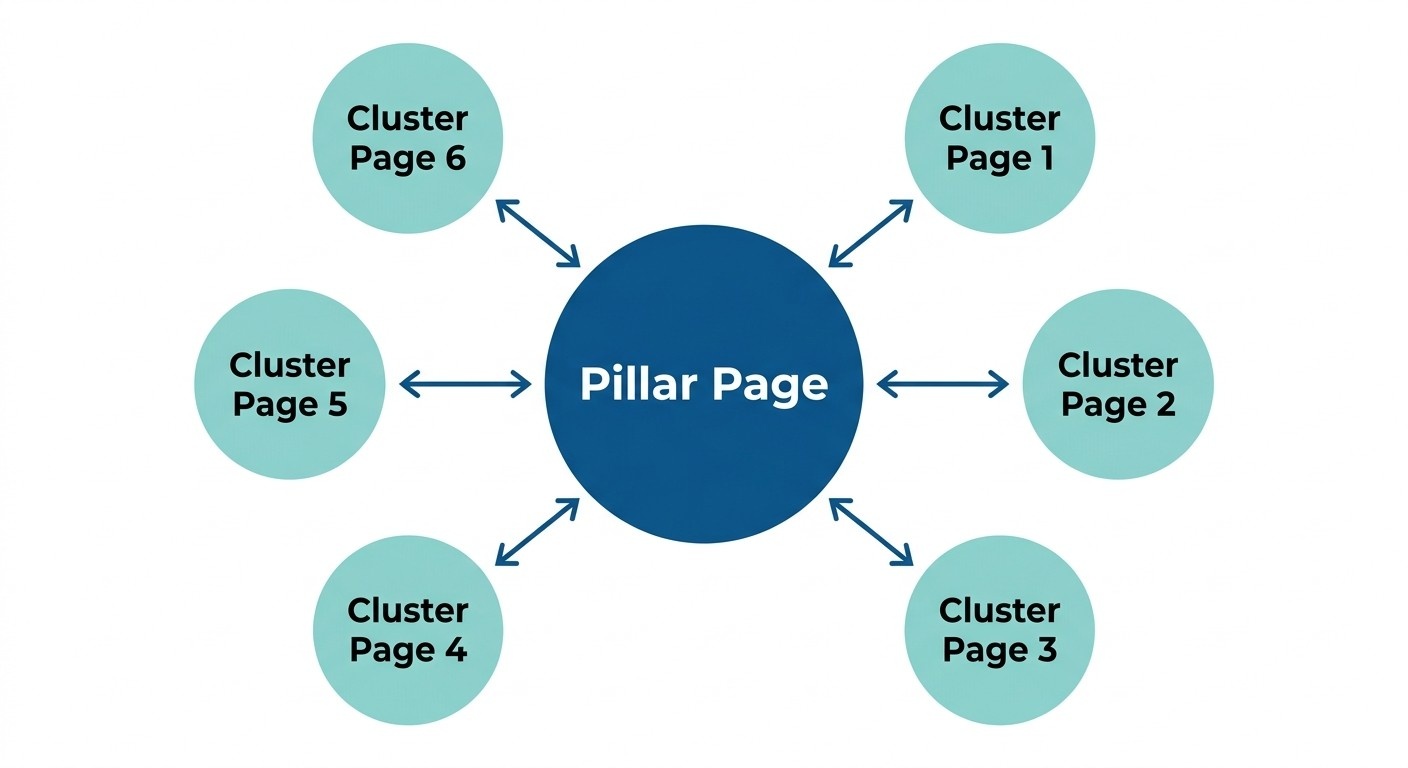
The pillar page and cluster model are the basis of topical authority:
- Pillar page. A page that provides a large, comprehensive overview of a main topic. This can be called a “hub.” This is often a long guide (2,000–5,000 words), which touches on all the main subtopics but does not go into much depth.
- Cluster pages. Separate articles that cover each subtopic in depth. These articles are linked to the pillar page and to each other where necessary.
For example, a cooking website looking to build topical authority around “bread baking”:
| Pillar Page | Cluster Page |
|---|---|
| The Complete Guide to Baking Bread | How to Make Sourdough Starter |
| Why Bread Dough Doesn't Rise (and How to Fix It) | |
| Best Flour Types for Bread Baking | |
| Bread Hydration Explained | |
| How to Score Bread Before Baking | |
| Baking Bread Without a Dutch Oven |
Each cluster page clearly answers a specific question that a bread baker might ask. From the inside, all the pages link to the column page, and the column page links to all the clusters. Google easily understands this structure and concludes that your site has deep and organised knowledge about bread baking.
How to Build Your Topical Map
A meaningful SEO topic map is a planned list of all the articles needed to fully cover a topic. Here’s how to create one:
Step 1: Choose your main topic. Make it as clear and specific as possible. You might be better off with a topic like “strength training for women over 40” than a very broad topic like “fitness.”
Step 2: List all the questions your audience might ask. Google’s “People Also Ask,” auto-suggest, Reddit threads, and various forums are all useful. Tools like Ahrefs or Semrush can help, but you’ll get better ideas if you do your own research.
Step 3: Group those questions into subtopics. Create clusters by putting similar questions together. Each cluster can become a separate piece of content.
Step 4: Choose your pillar page. The broadest and most basic question is usually the pillar page.
Step 5: Plan internal linking from the start. Don’t just think about linking after you’ve published your content. Make it clear before you write how each page will link to where.
Expert Tip: Most SEOs publish the column page first and then create the cluster pages. But it can be more effective to do it the other way around. Create and publish 5-7 cluster pages first, then bring in the column page. This creates a whole network of supporting content linked to the column as soon as it goes live, giving Google a strong signal from day one.
How to Build Topical Authority Step by Step
Creating a timely authority is not a project that can be completed in a week. It is an ongoing process. But the steps are clear.
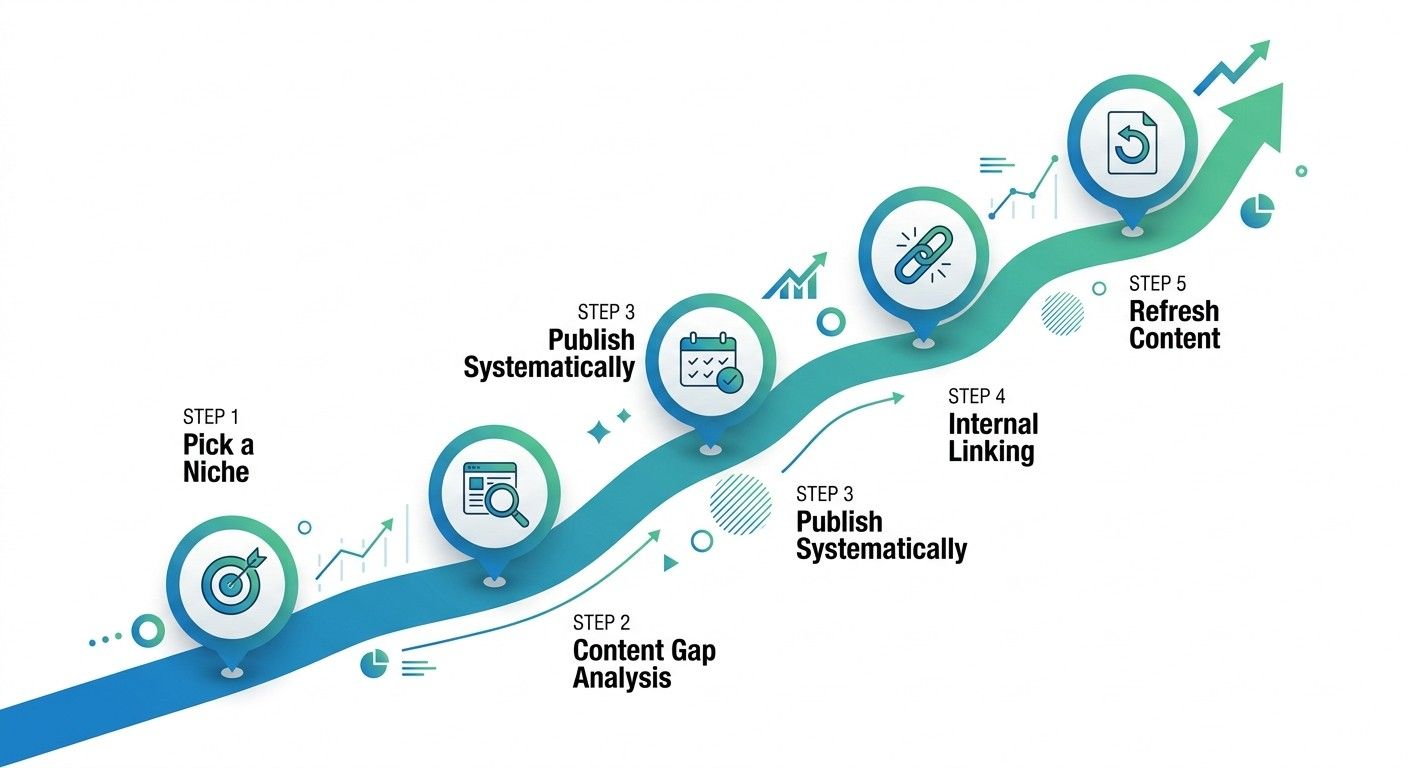
Step 1: Choose a niche you can handle well
The biggest mistake is to choose a topic that is too broad. Trying to establish authority in a large field like “marketing” is like trying to become the world’s top expert in “science.” So choose a small but clear sub-niche where you can provide complete coverage.
Narrow focus wins. For example, a site focused on email marketing for an e-commerce brand can build topical authority faster than a general digital marketing blog.
Step 2: Analyse the content gap
First, look at what’s already on your site. Then figure out what questions you still have unanswered in your niche. This gap is your content roadmap.
A simple way is to Google your main topic, open the top 5 results, and note the subtopics they cover that you haven’t covered. Then go deeper from there. Aim not to just match them, but to surpass them.
Step 3: Publish Content Systematically
Continuity is key to building topical authority. Publishing 20 relevant articles in two months is much more effective than publishing 20 unrelated articles over two years.
Create a clear content calendar based on your topical map. Cover each cluster systematically. Over time, as your site begins to show depth on a single topic, Google will start to notice it.
Step 4: Get your internal linking right
Internal links are the main way to connect your content clusters. They help Google understand how your pages relate to each other and make the overall structure clear.
Some simple rules for internal linking:
- Each cluster page should link to its own column page.
- Column pages should link to all cluster pages.
- Cluster pages should also link to other related cluster pages.
- Keep anchor text clear and meaningful. It’s better to use the topic name directly than “click here.”
Step 5: Keep updating and refreshing your content
Outdated content weakens your topical authority. So make it a habit to audit your content at least twice a year. Update statistics, create new examples, and improve articles that aren’t performing well.
Google always prioritizes fresh and accurate content. A well-updated content cluster performs much better than static content that’s left alone.
Expert Tip: When updating old content, pay attention to “query completeness.” Does this page answer all the relevant questions a user might ask? If not, add a new section. The goal is not just to provide accurate information, but to provide as complete coverage as possible within the scope of your topic.
Common Mistakes That Undermine Topical Authority
Even experienced SEOs make these mistakes. If you know these things in advance, it’s easier to avoid them.
Writing for Too Many Topics Simultaneously
Spreading your content across multiple unrelated niches confuses Google. After all, it’s not clear what your site is really about. When you cover cryptocurrency, parenting, and travel hacks all in one place, it’s hard to establish a good authority on any one of them. If your site currently has a mix of topics like this, consider creating a separate subdirectory or microsite for each. Otherwise, choose one main topic and focus on it, and gradually de-prioritize the rest.
Ignoring Search Intent
Creating content around keywords that don’t match the searcher’s actual intent is a surefire way to high bounce rates and poor rankings. A page that simply lists the history of “Sourdough Bread” as its title won’t perform well. Because most people want to know how to make it.
Always look at the SERPs before you write. What format did the top pages use? What did they cover? Match the intent first, then go deeper and differentiate.
Thin Cluster Pages
A content cluster filled with tiny 400-word stub articles does not build topical authority. Rather, it weakens it. Each cluster page should provide a complete and clear answer to its target question.
A short article is fine if the question is simple. But don’t make the mistake of creating superficial and thin content just to tick off a topic from the list.
Not Interlinking
Publishing large cluster pages without linking them together is like building a house with only rooms and no hallways. Google can’t build a clear map of your expertise, and users can’t easily navigate to related content. Ultimately, it’s uncomfortable for both parties.
Expert Tip: One important thing that many SEOs overlook is not just spoke-to-hub linking, but also “spoke-to-spoke” linking.
When two cluster pages are closely related (such as “Bread Hydration” and “Bread Flour Types”), linking directly between them creates a denser topical structure, which strengthens the authority of both pages.
Tools That Help Build Topical Authority
Expensive tools are not necessary to create timely authorizations, but some tools make the process much faster and easier.
For topic and keyword research:
- Ahrefs or Semrush. These are very useful tools for finding content gaps, keyword clustering, and competitive analysis. Both are used worldwide and usually have a trial version available.
- Google Search Console. This is a free and essential tool. It shows you which queries your pages are already ranking for, which makes it easy to find new content opportunities.
For content planning:
- Notion or Trello. These are handy tools for planning your content structure and tracking content production.
For internal link audits:
- Screaming Frog (free for up to 500 URLs). It crawls your site and shows you how pages are connected to each other, which makes it easy to find weaknesses in internal linking.
Conclusion: Topical Authority Is a Long Game Worth Playing
Topical authority in SEO is not a trick or a shortcut. It’s a big shift in the way you look at content strategy. It’s about moving from thinking about “what keywords do I want to rank for” to thinking about “what do my audience need to know, and have I answered all of them?”
The sites that come out on top in search today aren’t just the ones with the most pages or the most links. They’re the sites that provide truly useful, in-depth, and well-organized content on a specific topic.
Start small and clear in your niche. Create your topical map. Publish content regularly. Link thoughtfully. Update it regularly. If you do this for 12-18 months, you’re not just ranking. You’re building a very strong position in your topic.
To understand more, see how semantic SEO and E-E-A-T guidelines work with topical authority. These are the basis for everything mentioned here.
FAQ: Topical Authority in SEO
How long does it take to build topical authority?
This depends on your competition, how quickly you publish content, and the quality of your content.
In a niche with less competition, if you work consistently, you can see a good level of topical authority within 3–6 months.
But in a niche with more competition, it may take 12–24 months of consistent and focused effort.
Can a new website build topical authority?
Yes. In some ways, it can be easier for new sites. If a well-organized content cluster strategy is adopted with a clear niche focus from the start, a new site can build topical authority more quickly than an older, unfocused site.
Start with a narrow scope, cover it in depth, and then expand.
How many articles do I need for topical authority?
There is no magic number for this. The key is coverage. It depends on whether you are answering all the meaningful questions your audience is asking about that topic.
For most niches, a single column page and about 10-20 well-crafted cluster pages provide a solid foundation.
Does topical authority replace the need for backlinks?
No, but it does reduce the reliance on backlinks. In niches with low to moderate competition, strong topical authority can provide good rankings without too much aggressive link building. But in highly competitive areas, both may be necessary.
See them as complementary, not alternatives to each other.
Can I build topical authority in multiple niches on one site?
It’s possible, but it’s not easy. Google looks at the coherence of the entire site, and having too many unrelated niches on the same domain weakens each other’s authority signals. If you have to cover multiple topics, use a clear subdirectory structure (e.g., site.com/fitness/ and site.com/nutrition/) and develop each cluster separately.