
The Best Tool For low keyword
Many bloggers spend months working on content, posting it, and then are disappointed to see it sitting on page 4. They think the writing was good, the topic was right, but why didn’t it work? The real problem is often the keywords. Too competitive, crowded, and chosen based on numbers alone don’t tell the whole story.
This is where LowFruits comes in. It doesn’t just show you the keyword difficulty score, but also shows you who is actually ranking for them and whether you can beat them.
This review will cover everything you need to know: how it works, how much it costs, where it falls short, and ultimately whether it’s worth your investment.
What Are Low Fruits? (The Quick Version)
Featured Snippet: Low Fruits is a keyword research tool that helps you find opportunities with low competition and easy ranking by analyzing the SERP (Search Engine Results Page) structure deeply. Specifically, it examines whether the top 10 results comprise forums, low-authority websites, or pages with thin content.
What’s special about this tool is that it doesn’t just show you data, but also helps you understand practically how easy or difficult the actual competition is.
In terms of pricing, Low Fruits uses a credit-based model, which starts at $25. This means you don’t have to pay a large monthly fee—you only pay for what you use. This makes it an easy and accessible option for bloggers, niche site builders, and affiliate marketers.
It works in 4 steps:
- Enter a seed keyword in the keyword finder
- First, you enter a base (seed) keyword . Which is where all the research begins.
- Generate long-tail keyword ideas
- Low Fruits uses Google autocomplete to pull out related long-tail keywords, which are often less competitive.
- Analyze SERP data
- When analyzing the keywords you choose, the tool pulls SERP data directly and shows you what the top results are.
- Identify “weak spots”
- Finally, the tool highlights opportunities where forums, Reddit, Quora, or low-authority (low DA) sites are ranking .which could be a good opportunity for you to break into.
The main idea behind Low Fruits is that traditional keyword difficulty (KD) scores don’t show the full picture of real competition. KD is often based on metrics like average domain authority, but it doesn’t capture the deeper reasons why certain pages are actually ranking.
For example, a keyword might appear “moderately difficult” because the top sites have decent authority. But if those same top 10 results contain Reddit posts, Quora answers, or simple forum threads, that’s a sign that Google doesn’t have strong, high-quality content there.
What this means is that the real competition may be much easier than KD suggests.
That’s the real advantage of Low Fruits. It doesn’t just show you the numbers, but the real “battlefield” of who’s ranking, why, and whether you can take that spot.
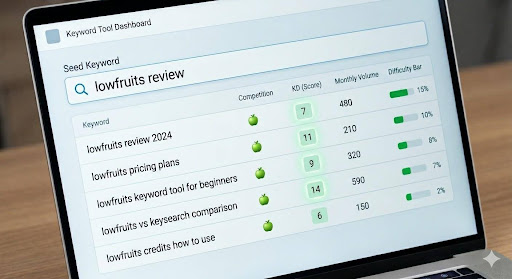
LowFruits pulls long-tail keyword ideas directly from Google Autocomplete, which is based on real user search behaviour. These keywords are often less competitive, so they’re easier for new websites or sites with low domain authority to rank for.
You enter a broad seed keyword like “home gym equipment” and then the tool will generate hundreds of variations. This is where LowFruits stands out a bit.
Its wildcard (*) search feature is very useful. You can use * to find keyword combinations that other tools don’t easily show.
For example:
“Home gym equipment for small spaces” is a straightforward search.
But using a wildcard like “home gym * for apartments” will find new, less-competitive angles based on the different words in between.
While this may seem like a small feature, its impact is huge. It can give you content ideas that your competitors haven’t yet targeted, and that’s where the real opportunity lies.
Expert Tip: Don’t just rely on the auto-generated keyword ideas provided by LowFruits.
Use a tool like Google Keyword Planner to confirm volume first. Then bring those keywords into LowFruits for SERP analysis.
This tool works especially well when you’re bringing in keywords from external sources and analysing them in depth.
SERP Weakness Analysis
This is where LowFruits makes its mark.
When you analyse a keyword, it pulls out the actual top-10 search results and evaluates how strong each page is. It then clearly shows weak spots in the SERP, such as sites with low domain authority. This allows you to save time by analysing the SERPs for multiple keywords at once.
Its visual system is also easy to use. A green fruit icon indicates a good opportunity, while a blue icon indicates a result with forum or user-generated content. This way, you can identify good opportunities at a glance, without having to read each result one by one.
Real-world example: Let’s say you’re running a new personal finance blog. You’re thinking of targeting the keyword “best budgeting apps for college students.”
Simple tools show it to have a KD of 38, which makes it seem like a moderately competitive keyword.
But when you import it into LowFruits, you see that positions 3 and 5 are occupied by Reddit threads and Quora answers.
This is a real sign that there’s a void.
In this case, a well-written and structured original article has a real chance of competing with even a small site with DA 15.
Expert Tip: A high-value dropshipping store with hundreds of potential keywords can easily find out what appears in the top 10 by using LowFruits’ SERP analysis. Such results are often a clear indication that there is a void, and it is most useful to create content that prioritises those keywords.
Keyword Clustering
LowFruits groups keywords with similar intent into clusters, which makes it easier to plan your content.
Instead of writing 50 different keywords in 50 separate posts, you can clearly see which keywords fit into one big, in-depth article.
This isn’t as common as many people think. Google’s Helpful Content update prioritises in-depth content that’s written with a good understanding of the same topic, rather than content that just repeats keywords.
So creating a keyword cluster before you start writing is one of the most effective SEO decisions you can make.
Domain Explorer
LowFruits’ Domain Explorer has a large database of very weak websites for competitive analysis.
It lets you select a specific domain and see what keywords that site is ranking for, especially when its DA is low compared to other results.
This is very useful for competitive research. You can identify small but well-performing sites in your niche, and reverse-engineer them to see what keywords they are working on.
Rank Tracker
LowFruits’ keyword rank tracker can track up to 100 keywords on the standard plan and 500 keywords on the premium plan. It’s not as advanced as dedicated rank tracking tools like SERPWatcher, but it’s more than enough for solopreneurs or small publishers who don’t need detailed tracking daily.
Bulk Import
LowFruits also offers bulk keyword import, keyword lists, and shareable reports.
This feature helps organise research and facilitate collaboration, especially when working in teams.
This is especially useful for content agencies that work with large lists of keywords in spreadsheets and need to check them all at once.
Low Fruits Pricing: Credits, Plans, and What You Actually Get
Low Fruits uses a credit-based system, which works a little differently from most SEO tools. Understanding this up front can help you avoid confusion or frustration later.
Pay-As-You-Go (PAYG) Credits
Users who use the PAYG (Pay As You Go) system get three free keyword searches per week.
After that, each additional search costs one credit, and each keyword analysed costs one credit.
The pricing structure is as follows:
- 2,000 credits: $25
- 5,000 credits: $60
- 10,000 credits: $100
- 50,000 credits: $250
PAYG credits expire one year from the date of purchase.
What’s not included in PAYG: Pay-As-You-Go credits do not include unlimited access to features like boosted keyword finder, keyword rank tracker, domain explorer, competitor keyword extraction, sitemap extraction, and free report downloads.
Subscription Plans:
As of April 2026, the standard plan costs $29.90 per month (or $249 per year) and provides 3,000 credits per month.
All subscription plans include features like boosted keyword finder, domain explorer, competitor keyword extraction, sitemap extraction, unlimited report downloads, and a 10% discount on PAYG credits.
Important: Subscription credits reset each month and do not carry over to the next month.
Quick Pricing Decision Guide:
- Users who do occasional research (less than 30 keywords per month): PAYG is often the cheapest option
- Actively publish content (50–100+ keywords per month): Standard subscription is more useful
- Agency or very high volume users: Premium plan or full SEO tool suite may be a better option
Expert Tip: If you’re consistently using less than the 3,000 credits on the standard plan, you’re likely paying more than you would if you were buying PAYG credits. So before you run for any plan, it’s a good idea to do a simple calculation of how many keywords you actually research per month.
Low Fruits Pros and Cons
What Low Fruits Does Well
Low Fruits looks at keyword difficulty a little differently.
Most tools reduce competition to just a single number.
But here, you’re shown the actual structure of the SERP: who’s there, how strong they are, and whether there’s really any opportunity.
This approach is considered a very practical and accurate way to evaluate keywords.
Low Fruits is an affordable entry-level option. It’s much cheaper than popular tools like SEMrush and Ahrefs.
It’s especially good for users who want to focus on keyword research raoptimizationlot of extra features.
Low Fruits focuses on simplicity and affordability. Its interface is clean and easy to understand, without too many complicated dashboards or unnecessary setup.
You can get started in minutes and get straight to keyword research and work.
There is no forced commitment at Low Fruits. There is no long onboarding or pressure to subscribe right away like other SEO tools.You can start at your own pace and learn slowly.
Low Fruits offers bulk analysis. Manually checking hundreds of keywords one by one can take hours.
But here, all those keywords can be analyzed at once, which is a real time saver.
Where Low Fruits Falls Short
Search volume data isn’t real-time. Low Fruits uses data from Google Keyword Planner, and may cache that data. Therefore, it is important to understand that sometimes the search volume you see may not fully reflect the latest trends.
Credits run out faster than you expect. Credits can run out quickly. Each keyword analysis costs one credit. If you’re researching 50–100 keywords a day, 3,000 monthly credits can run out in a few weeks.
Not a full-suite SEO tool. Low Fruits is a tool primarily designed for keyword research.
It doesn’t have advanced features like site audits, backlink analysis, or content optimization, and rank tracking is limited to the basic level.
So using it alone won’t get you everything done. You’ll usually need to use other SEO tools along with it.
Post-HCU complexity.After Google’s Helpful Content Update, pages like forums and Reddit have started to appear higher in many cases intentionally. This is not always because they have weak content.
Previously, the appearance of a “blue icon” was considered a sign of an easy opportunity, but now that signal is not as reliable as it used to be.
Because Google now also considers community experience (forums, user content) as a good answer for some queries, understanding the SERP requires a deeper analysis.

Low Fruits vs. Key Search: Which Low-Competition Keyword Finder Wins?
Both tools serve budget-conscious SEOs looking for achievable keyword opportunities. But they approach the problem differently.
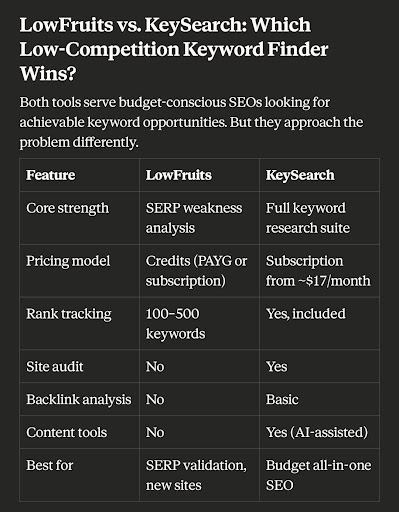
Key Search is one of the lesser-known but well-regarded tools in the blogging community.
For around $17 per month, it offers keyword research, difficulty scores, competitive analysis, site audits, rank tracking, and tools to help you create content.
Some of these features are not available in LowFruits, so using both can be useful for different purposes.
To be honest, these two tools aren’t exactly direct competitors, as they work in different ways.
LowFruits is a specialist tool. It focuses on one thing: finding weak spots in SERPs, and it does that job very well.
KeySearch, on the other hand, is a more general-purpose tool. If you’re running a growing site and want to do a lot of SEO work with a single tool, it’s a good fit.
Simply put, KeySearch is strong in breadth, while LowFruits is more in depth in terms of “can you really rank for this keyword”
That’s why many serious content publishers use both:
KeySearch helps you find keywords on a large scale, and LowFruits is the ultimate proof of which ones are really worth winning.
Expert Tip: When creating a new content site, first run your seed keywords in KeySearch to generate a large keyword list.
Then, take the keywords that perform well out of them and run SERP analysis on LowFruits.This way, you get a large amount of keyword ideas on the one hand, and on the other hand, you also get a deep analysis of the SERP weaknesses.
Who Should Use Low Fruits?
Best fit:
- Bloggers and niche site builders starting with DA under 30
- Affiliate marketers specifically targeting long-tail opportunities
- Content agencies doing keyword validation at scale
- SEO professionals already using Ahrefs or SEMrush, but who need a more specialized SERP scanner
Not a good fit:
- Sites with DR 50+, who may already be competing for difficult keywords. In that case, tools like Ahrefs or SEMrush are more suitable.
- Users who need a complete SEO suite (site audit, link building, content optimization) in one tool.
- Teams that do a lot of keyword research daily, who risk running out of credit quickly if they don’t budget carefully.
Final Verdict
LowFruits is a focused and affordable tool that solves a specific problem well: showing whether a keyword is actually worth winning, not just looking at the KD score.
Its main users are SEO practitioners, content site builders, niche site operators, and affiliate marketers. Many use it alongside their main SEO platform, not as a replacement for SEMrush or Ahrefs, but as a tool to help you identify real opportunities beyond the KD that those tools show.
If you are running a new or growing site and want to generate traffic without spending time and money on unnecessary competition, this tool is worth serious consideration. It is best to test the workflow with the PAYG option first, and only then decide to go for a subscription.
Visit LowFruits.io to use the free tier of LowFruits and see the SERP weakness analysis for yourself.