
Table of Contents
ToggleWhat is AI SEO? How Artificial Intelligence Changes SEO
Google processes billions of searches every day, and many of those results are now determined by machine learning systems working quietly, rather than by humans. So sometimes, when your website traffic seems to be dropping or increasing for no apparent reason, AI could be behind it.
AI SEO isn’t a thing of the future; it’s already deeply embedded in our digital world. How Google ranks websites, how marketers find the right keywords, and how large amounts of content are created—AI is playing a role in all of this. You don’t have to be a tech expert to understand it, but ignoring it is a missed opportunity.
In this guide, you’ll find an easy-to-understand explanation of what AI SEO is, how it works in practice, and what you need to do to stay ahead of the competition, whether you’re a new blogger or a marketer managing multiple websites.

What Is AI SEO, Exactly?
AI SEO refers to the use of artificial intelligence techniques such as machine learning, natural language processing, and large language models to improve how websites rank in search engines and how search engines themselves evaluate and rank content.
AI SEO Meaning works in two ways:
AI in search engines:
Google uses AI to understand user search intent better, assess content quality, and match queries with the most relevant results.
AI for marketers:
SEO professionals use AI-powered tools to conduct keyword research, analyse websites, generate new content ideas, and predict which content is likely to rank well.
Both aspects are changing rapidly, and both have become extremely important for anyone looking to increase organic traffic.
A Brief History: From PageRank to RankBrain
Google’s early algorithm was essentially a popularity contest, with the page with the most links coming up. It was easy, but it was also easy to game.
Then came RankBrain in 2015, Google’s first major AI-based ranking signal. It utilised machine learning to comprehend searches that had never been encountered before. Then came BERT in 2019, which helped to better understand how words in a sentence are connected. Then came MUM, which brought the ability to understand not just text, but also images and videos together.
All of these updates moved Google away from simple keyword matching and towards understanding real language and meaning. So now the old ways of keyword stuffing don’t work, and E-E-A-T experience, expertise, authority, and credibility have become the most important foundations in SEO today.
How AI Changed the Way Google Ranks Content
The essence of understanding artificial intelligence and SEO is that Google is now not just looking at the words you write, but is also trying to understand the real meaning of what you are trying to say.

Natural Language Processing (NLP)
Thanks to NLP, Google can now understand not just keywords, but also context. For example, when someone searches for “how long to cook chicken thighs,” Google doesn’t just show pages that match those exact words. Instead, it brings up pages that provide a clear and useful answer to the question asked, even if the words are slightly different.
To give you a real-world example, a recipe page with the phrase “Boil chicken thighs at 425°F for 35–40 minutes” can rank well for the original query even if it doesn’t use the same keyword. This is because AI understands the relationships between words, not just isolated keywords. So instead of writing for crawlers alone, content written in a way that is useful to humans will yield better results.
Google’s Search Generative Experience (SGE) and AI Overviews
Google launched AI Overviews in 2024, where AI-generated summaries appear at the top of many search results. This creates a new situation. AI already pulls information from web pages and shows answers, so users sometimes get answers without having to click on a website. This means two things in terms of SEO. First, being seen as a resource within AI Overviews is now becoming a new kind of “ranking.” Second, content that goes beyond just general informational content and offers real experiences, in-depth analysis, and original ideas can still attract users to click, even when AI is showing a summary above.
E-E-A-T: The Human Element Google Still Rewards
Google’s quality guidelines emphasize experience, expertise, authority, and credibility (E-E-A-T). The “experience” (first E) added later is specifically to discourage generic AI-generated content and prioritizes real-life experience. For example, a blog written by a certified fitness trainer who shares their personal results and exercises is more likely to perform better than a content-farm site that simply repeats generic information. Google’s AI can recognize such differences to some extent. Not perfectly, but enough to affect rankings.
AI for Search Engine Optimization: How Marketers Use It
If Google is using AI to rank your site, you too can use AI to improve your site. This is where AI really becomes useful for SEO.
Keyword Research at Scale
Traditional keyword research used to be like opening a spreadsheet, sorting keywords by volume, and guessing the intent behind them.
But AI tools have changed this process dramatically.
Platforms like Semrush, Ahrefs, and Surfer SEO now use machine learning to group keywords by topic, identify meaningful relationships between them, and even predict which keywords are likely to become popular soon.
This makes it easier to create entire content clusters around a single topic, rather than focusing on individual keywords, which is much more effective in less time.
Real example: A travel blogger writing about “budget travel in Japan” can use an AI keyword tool to find over 40 related keywords. For example, “cheap cities in Japan”, “is the Japan Rail Pass worth it”, “free things to do in Tokyo”. He can then create a complete content strategy by combining all these topics, rather than just one article.
Content Creation and Optimization
AI writing tools (Copy.ai, Jasper, etc.) have become commonplace in many content creation processes. But here’s the important thing: whether to use AI to improve your writing or leave it to your imagination.
Blogs and pages that rank well are often not 100% AI-generated and published as-is.
They are content where a person with real experience and expertise uses AI to help draft, structure, or identify missing topics, and then edits it themselves to add real insights.
Where AI genuinely helps:
- Preparing an outline structure
- Writing a first draft of factual sections
- Rewriting to improve clarity and tone
- Identifying missing subtopics
Where humans still win:
- Share real experiences and ideas
- Include your own data or case studies
- Build trust through a consistent voice and style
Technical SEO Audits
AI-powered crawlers can audit hundreds of pages at once, quickly identifying broken internal links, missing schema markup, duplicate content, slow page speed, and even
and hard-to-notice issues something that could take days to fix manually.
Tools like Screaming Frog (with its AI integration) and Content King now offer anomaly detection, which alerts you immediately when traffic drops or rankings change, so you can fix small problems before they become big ones.
AI SEO Tools Explained: What’s Actually Worth Using
There is no shortage of tools that claim to be “AI-powered.” But to make them easier to understand, here are the main categories:
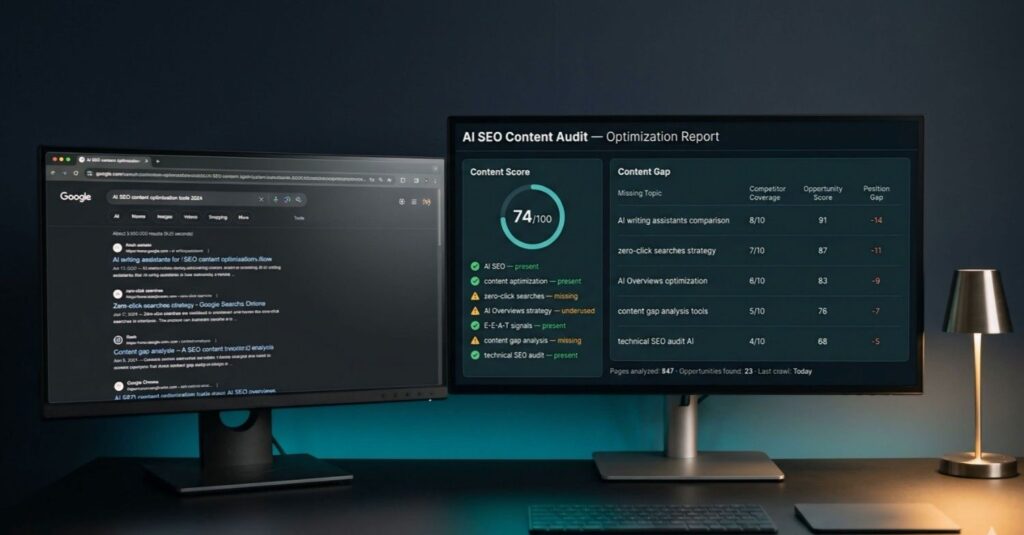
Content Optimization Tools
Surfer SEO analyses the top-ranking pages and shows you which topics, headings, and words are missing in your content. It’s not magic, but it’s a useful analysis tool to help you avoid glaring gaps in your content.
Clearscope does a similar job. It scores your content against your target keywords and suggests related words to add. This is useful for writers who want simple guidance without too much in-depth analysis.
AI Writing Assistants
ChatGPT and Claude are designed for general purposes, but they are very versatile. They are good for brainstorming, drafting, and editing, but not as a “set-and-forget” system where you can just take out the finished content and use it as is.
Jasper is specifically designed for marketing content, with ready-made templates for blog posts, product descriptions, and ads. It’s useful if you need a lot of content and have a robust editing process.
SEO Research Platforms
Semrush and Ahrefs include AI-based features for keyword clustering, content gap analysis, and competitive research. If you’re already using one of these platforms, it’s worth checking out their AI tools as well, as they can save you a lot of time in real time.
Real example: A SaaS company used Semrush’s AI-powered Keyword Magic Tool to identify a group of mid-funnel keywords that their competitors were ranking for but they weren’t targeting. They then published six targeted articles over three months, resulting in an estimated 4,000+ additional monthly organic visitors.
The Future of SEO AI: Where Things Are Headed
The future of AI in SEO isn’t a one-time, massive change. It’s a series of small but consistent changes that happen gradually. Those changes are already happening and are becoming more apparent.
Search Is Becoming Conversational
Voice search, AI chat interfaces, and Google’s own AI Overviews are now teaching users to ask complete questions rather than just typing in small keyword fragments. A simple search like “best running shoes” is now evolving into a more detailed query like “what running shoes are best for wide feet and knee pain?”
For this reason, content that answers these nuanced questions in clear, specific, and natural language is more effective in this changing environment than content that relies solely on simple keywords.
Zero-Click Searches Will Grow
When Google (or an AI Overview answers a question directly, the user doesn’t have to click through to the website every time. Zero-click searches were already on the rise, and AI Overviews are making this even more so.
The solution isn’t to create bad or low-quality content. Instead, it’s to create content that compels the user to click, such as original research, expert insights, useful tools, calculators, or in-depth information that a two- or three-sentence AI summary can’t provide.
AI Detection and Authenticity Signals
Google has made it clear that it doesn’t penalize content that is created by AI. It does penalize low-quality content, no matter how it’s created.
But as the web becomes increasingly saturated with generic AI content, signals of authenticity are becoming increasingly important. Bylines like author bios, first-person experiences, and links to real social profiles make your content more trustworthy.
Creating a clear and recognizable author brand associated with your content is becoming increasingly important not only for reader trust, but also for better rankings in today’s SEO.
FAQ: Common Questions About AI SEO
Does Google penalize AI-generated content?
Not automatically. Google prioritizes high-quality content over how it’s produced. But thin, irrelevant, or repetitive AI content that appears to be without editing or real expertise will be filtered out. Ultimately, it’s the quality that matters, not the source of the content.
Can AI tools replace an SEO specialist?
Not yet, and it’s unlikely to happen in the near future. AI tools are great at analyzing data, identifying patterns, and preparing first drafts. But it still takes human experience and expertise to make strategic decisions, understand the psychology of specific audiences, and build deep topical authority over time.
What is the best AI tool for SEO beginners?
For beginners, it's best to start with free or inexpensive tools that aren't too complicated. Using an AI writing assistant like ChatGPT or Claude to generate content ideas, along with using Google Search Console (free), can be a great starting point before investing in paid tools.
How does AI affect keyword research?
AI has completely changed keyword research, as it now helps group keywords based on user intent, not just search volume. Instead of targeting individual keywords like before, AI tools now help you build content around a single topic, which aligns much better with the way Google now understands and groups search queries.
Is AI SEO only for big websites?
No. In fact, smaller sites can benefit even more in many cases, as AI tools enable even a single person to do the work that previously required an entire team. Now a single blogger can audit their own site, research entire content clusters, and improve existing pages in a fraction of the time, which previously would have taken a lot of time and resources.
Conclusion: What This Means for Your SEO Strategy
What is AI SEO?
It’s about understanding that both Google and the marketers who compete with it are now using machine intelligence to work faster, smarter, and on a larger scale than ever before.
This doesn’t mean SEO is dead, and it doesn’t mean that only big tech companies can compete. Rather, the bar for “good enough” content has risen higher than ever, and the tools needed to surpass that bar are now within reach of many.
In practical terms, use AI to work faster and more efficiently, but don’t delegate your real expertise to others. AI can’t replicate your real experience, your own perspective, and your ability to deeply understand your audience, and Google’s AI is increasingly trying to identify these things.
Start with just one AI tool that solves a real problem in your daily work. Test your content with an optimization tool before publishing. Look back at your best-performing articles and find areas for further depth. These small but consistent improvements add up over time.
Ultimately, the future of SEO is not AI humans. It’s about humans doing a better job using AI.
SEO Output
Meta Description
A clear guide for beginners and marketers to understand what AI SEO means, how Google uses AI in content ranking, and which AI tools can really improve your rankings.
Internal Link Topic Suggestions
How to do keyword research for beginners? Link from the keyword research section where semantic clustering and topic mapping are mentioned.
What is E-E-A-T and why is it important for your blog” Link from the E-E-A-T sub-section; directly related to building trust and authority.
“Best SEO Tools for Bloggers in [Year]” Link to a detailed tool list from the AI SEO Tools section.
Additional FAQs (if needed beyond article)
1.What is the difference between traditional SEO and AI SEO? Traditional SEO focused heavily on keyword placement and link building as isolated tactics. AI SEO incorporates machine learning tools on both sides; search engines use AI to understand intent, and marketers use AI to research, create, and optimize more efficiently.
2.Is AI SEO expensive? Not necessarily. Many powerful AI features are built into tools people already pay for (Semrush, Ahrefs). Standalone AI writing tools start at around $20/month, and free tiers of tools like ChatGPT cover basic use cases.
3.How do I know if my content ranks in AI Overviews? Search your target keywords in Google and check if an AI Overview appears. If your page is cited as a source, it will show a link in the overview panel. Google Search Console may also surface impression data for these placements over time.
4.Will AI replace SEO jobs? AI is changing SEO roles rather than eliminating them. Repetitive tasks (reporting, basic audits, content briefs) are increasingly automated. Strategic thinking, creative direction, and brand-building remain human-driven.
5.How often should I update content for AI SEO? Refreshing high-traffic pages every 6–12 months is a good baseline. Pages targeting queries that appear in AI Overviews may benefit from more frequent updates to maintain citation eligibility.