
Many people rely on their own assumptions when choosing keywords. They type in a topic that comes to mind, write an article… and then wonder “Why isn’t my article showing up on Google?” The problem is often not with the writing. The truth is, they’ve entered a competition where there’s no chance of winning.
Keyword difficulty is a measurement that shows how difficult it is to get on the first page of Google for a particular search term. If you understand it correctly, you can drive good organic traffic even from a new website. But if you ignore it, the content you’ve worked hard on for months can end up stuck on the fourth page where no one will even look.
In this guide, we’ll explain in simple terms what keyword difficulty really is, how different tools measure it, and most importantly how to spot keyword opportunities that your competitors haven’t noticed.
Table of Contents
ToggleWhat Is Keyword Difficulty, Exactly?
Keyword difficulty (also often called keyword difficulty score) is a number, usually from 0 to 100, that shows how difficult it is for a keyword to rank high in Google’s organic results.
If the score is as low as 10 there’s a good chance you can rank even if you’re a new website.
But if the score is as high as 85 then you’re competing with big websites like Forbes, HubSpot, and Healthline. All of which have very strong backlinks and credibility.
Each keyword research tool calculates this score differently, but the bottom line is the same:
The higher the score, the tougher the competition.
That means you need more authority, more quality backlinks, and user trust to rank high.
What Goes Into a Keyword Difficulty Score?
No tool will reveal its exact formula, but most will calculate keyword difficulty based on a few key factors:
backlink profile First of the top 10 ranked pages is looked at. How many websites link to those pages? And how trustworthy are those websites themselves? The stronger the backlinks, the tougher the competition.
domain authority Then comes It’s not easy to beat long-standing, trusted websites. This can be a big challenge for a new site.
on-page SEO is How well-optimized are the top pages for your keywords? If they’ve got everything right, it’s hard to beat them.
Finally, SERP features are also very important. For example featured snippets, “People also ask” boxes, or ads. All of this can sometimes result in fewer clicks on the actual organic results, which directly impacts your traffic.
For example, Ahrefs bases its keyword difficulty score primarily on how many referring domains (i.e., links from different websites) the pages in the top 10 results have. The more quality links, the greater the difficulty.
On the other hand, Semrush takes a broader approach. It calculates its difficulty score not only by including link data, but also by including other factors like on-page SEO.
But the key point here is that none of these is “best.”
These are all just estimates. The final decision always comes down to your strategy, content quality, and understanding of the market.
Why Keyword Difficulty Matters More Than Search Volume
This is where most beginners make a mistake: they jump straight to high search volume, but completely ignore keyword difficulty.
A keyword with 50,000 searches per month sounds appealing. But think about it: what if all the results on the first page are 10+ year old websites with thousands of backlinks? In that case, no matter how good your article is, your chances of getting there are slim to none. The result? Almost zero traffic.
Let’s put it this way:
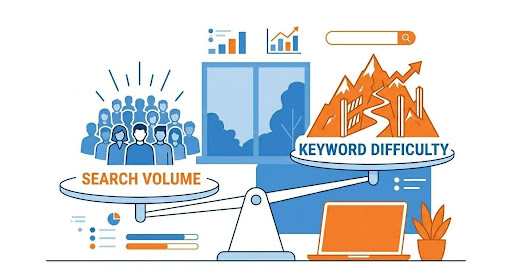
Search volume = reward
Keyword difficulty = cost
If you only look at reward and ignore cost, you’re playing the wrong game. The right strategy is to balance the two.
The Sweet Spot: High Opportunity, Low Competition
Keywords worth targeting are often in a “perfect balance” of sorts.
*First, the search volume should be moderate but meaningful. Even if you only get 300 to 1,000 searches per month, it can still yield good results if you bring in the right traffic.
*Second, the keyword difficulty should be low or moderate. It’s hard for a small or new site to survive on a keyword with a lot of competition.
*Third, most importantly, your content should accurately meet the user’s search intent. This is what ultimately determines your ranking.
For example, a keyword with a difficulty of as low as 18 and 800 monthly searches can easily outperform a keyword with a difficulty of 78 and 50,000 searches in many cases, especially for a new or less than two-year-old site.
Imagine you’re running a personal finance blog.
A keyword like “how to invest” is extremely competitive (80+ difficulty) and is already dominated by big websites.
But a keyword like “how to invest $500 as a college student” is different. There is less competition, the search intent is clear, and your content can directly target the right audience, so the chances of ranking are much higher.
How Different Tools Measure Keyword Difficulty
Not all keyword difficulty scores are created the same way. The same keyword might show up as a 30 in one tool, a 65 in another. Understanding why this difference occurs makes it easier to use these numbers correctly.
Ahrefs Keyword Difficulty
Ahrefs primarily looks at the average of the referring domains of the pages in the top 10 results when calculating keyword difficulty scores. It also gives you an estimate of how many backlinks you will need. This is why Ahrefs is especially useful for SERP analysis. You can see directly who you are competing with and you can actually see their backlink levels.
Semrush Difficulty Score
Semrush doesn’t rely solely on link data to calculate keyword difficulty. It also combines a number of off-page and on-page signals, such as domain authority signals, on-page SEO, and content quality, to create a score.
So sometimes the Semrush score for the same keyword may appear slightly higher than Ahrefs’, because both are measuring competition from different perspectives.
Free Options
If you don’t want to spend money on a tool, there are options.
Google Keyword Planner shows a simple competition like “low, medium, high.” This is mainly based on the competition for ads, but it can give a slight indication of organic SEO difficulty.
Similarly, tools like Ubersuggest and Moz also offer limited free keyword difficulty checks, which are good enough for initial research.
The truth is, whether it’s an expensive tool or a free one, the mindset is more important than the money when it comes to choosing good keywords.
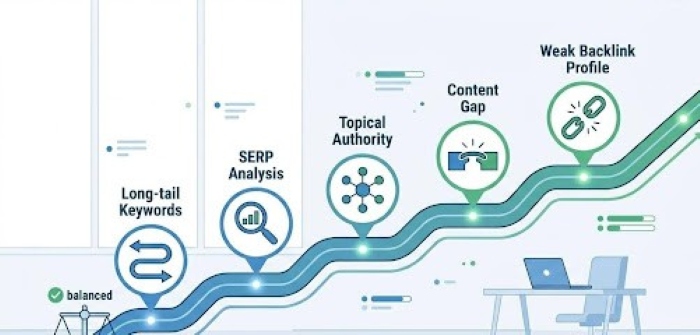
How to Beat Keyword Difficulty: 5 Practical Strategies
Knowing your keyword score is just the first step. Most people stop there. But the real work is using that information to create a strategy, and that’s where winning begins.
1. Target Long-Tail Keywords
Long-tail keywords are more specific search phrases with more words, usually 3 or more words.
These keywords often have less competition, so the keyword difficulty is also lower.
For example, a keyword like “weight loss tips” is very competitive. But a keyword like “weight loss tips for women over 50 with thyroid problems” is very specific and therefore easier to win.
These keywords have a smaller audience, but they are searching with a very clear intent, which leads to better conversions.
Another advantage is that long-tail keywords naturally support your main (short-tail) keywords. As your site gains authority over time, these keywords are more likely to rank for larger keywords.
For example, a keyword like “pasta recipes” (high difficulty) is difficult to target. But a specific keyword (less difficult) like “creamy sun-dried tomato pasta without cream” can rank quickly, attract the right audience, and even get shares or backlinks naturally.
2. Analyze the Actual SERP, Not Just the Score
Keyword difficulty scores are basically just averages. But the real game is in the SERPs.
When you search for keywords in incognito, you see the real situation
*Are there big authority sites at the top, or are there also some small blogs?
*Sometimes the pages there are not very strong, are old, weak, or have not been updated at all. In such cases, even if the score is average, there may be a good chance.
*Another thing is that if Google shows a featured snippet or other special box, you can get traffic from that place even if you don’t get the top position.
So sometimes even a keyword with a score of 45 can be easily won. If the current results are weak or old.
3. Build Topical Authority Before Targeting Hard Keywords
Google looks at your entire site, not just one page.
If you consistently write good and in-depth content about email marketing, Google will start to consider you a “trusted source” in that area.
What happens next is that even email marketing keywords that were initially difficult to rank for will start to rank easily over time.
This is often called topical clustering.
Covering small, easy keywords first, building authority from them, and then targeting larger, more competitive keywords.
4. Find Keyword Gaps in Competitor Content
Your competitors have already done a lot of research.
If you look at any SEO tool, you can easily see what keywords they are ranking for. Then you need to pay attention to whether they are ranking for that keyword, or if they are really covering that keyword well?
From there you find the “gap” where their content is weak, incomplete, or not deep enough.
That is where your opportunity lies.
If you cover that keyword in a clearer, better, and more useful way, you can take the traffic they are missing.
5. Prioritize Pages With Weak Backlink Profiles
Even if a keyword looks competitive from the outside, it doesn’t mean that all pages are keyword-related why it’s important to look at competing pages one by one, not just the domain.
Sometimes you’ll see that even though a page is in a good domain, it doesn’t have many backlinks. In that case, that page isn’t very strong.
Such a “weak page” can easily be overtaken by your well-optimized and properly promoted article.
Because in the end, it’s not just the strength of the domain that matters, but also how strong the individual page is.
Reading Keyword Difficulty Scores: A Quick Reference
Keyword | Search Intent | Difficulty Level |
|---|---|---|
reading keyword difficulty scores | Informational | Medium |
keyword difficulty explained | Informational | Easy |
how to read keyword difficulty | Informational | Easy |
SEO keyword difficulty guide | Informational | Medium |
keyword difficulty score meaning | Informational | Easy |
what is keyword difficulty in SEO | Informational | Medium |
keyword difficulty checker | Commercial | High |
low keyword difficulty keywords | Informational | Medium |
high keyword difficulty keywords | Informational | Medium |
keyword competition analysis | Informational | Medium |
understanding keyword difficulty | Informational | Easy |
SEO difficulty score chart | Informational | Medium |
keyword ranking difficulty | Informational | Medium |
easy SEO keywords | Informational | Medium |
keyword research difficulty metrics | Informational | Medium |
KD score in SEO | Informational | Easy |
keyword difficulty vs search volume | Informational | Medium |
best keyword difficulty for beginners | Informational | Easy |
how to choose low competition keywords | Informational | Medium |
SEO keyword competition score | Informational | Medium |
These are just general benchmarks. Always compare the scores with the actual SERP before making a final decision.